Spotted hyaenas are an extremely important component of the ecosystem, utilizing almost every part of their varied prey except for horns and rumen, and scavenging often.
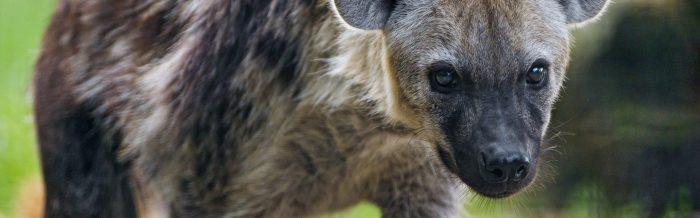
Join a creative community focusing on a unique animal each month.
FaunaFocus releases a new FaunaFact every single day! These bite-sized bits of information are interesting facts paired with a unique image of that animal.
Spotted hyaenas are an extremely important component of the ecosystem, utilizing almost every part of their varied prey except for horns and rumen, and scavenging often.
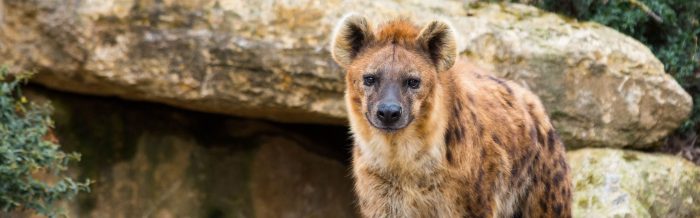
The spotted hyaena has the highest parental investment of any carnivore and feeds their young milk with an extremely high energy content.
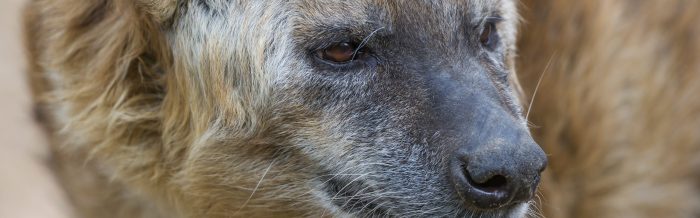
Spotted hyaenas are subject to human persecution through culling, shooting, spearing, trapping, poisoning, and vehicular strikes and may be legally killed when suspected to have preyed upon livestock.
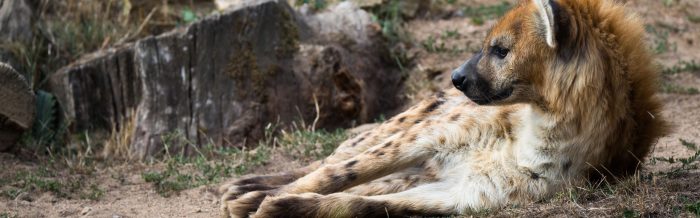
Every 11-21 months, a female spotted hyaena can give birth to 1-4 young through her phallic clitoris, rupturing it open and taking several weeks to heal.
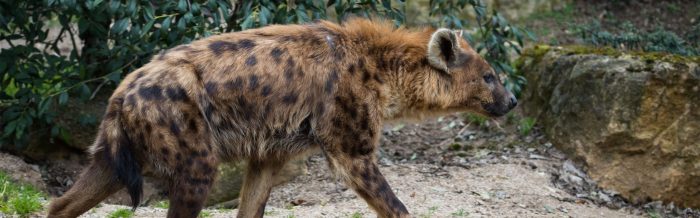
Spotted hyaenas inhabit a wide variety of habitats, including forest, savanna, grassland, and even human habitations.

Spotted hyaena clans defend their territories with vocal displays and scent marking and use communal latrines to mark territory boundaries.

Spotted hyaenas weigh 45-70 kg. (99-154 lb.) and are sexually dimorphic as females average 6.6 kg heavier than males.

Spotted hyaena clans are matrilinear and females are usually dominant over males, inheriting their ranks from their mothers.
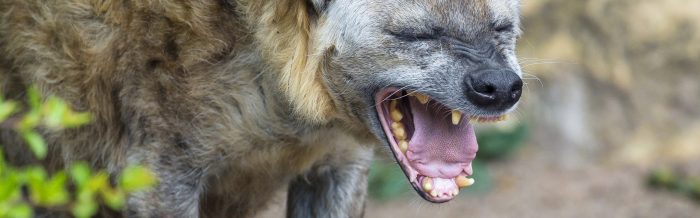
Spotted hyaenas have the strongest jaws in relation to its body size of any mammal.

Spotted hyaenas perform a phallic inspection as a greeting, where two individuals stand head to tail, lift their rear legs, and sniff each other's extended phallus for up to 30 seconds.

Unlike the aardwolf which has five toes, the spotted hyaena has four digits on each foot with short, non-retractable claws and broad toe pads.
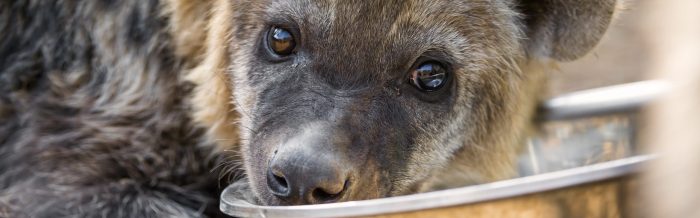
Spotted hyaenas are exploited for tourism, being fed by hand, shown on exhibition walks, or having their hair and skin collected for talismans or witchcraft.

Spotted hyaena mating is highly polygynous and aseasonal and can be difficult because of the female's reproductive tract.

The spotted hyaena is an endurance hunter and has adapted longer front legs than hind legs and a long, muscular neck in order to carry prey great distances while conserving energy.

Female spotted hyaenas are extremely masculinated and have genitalia that is almost indistinguishable from those of males, through which they must urinate, mate, and deliver young.
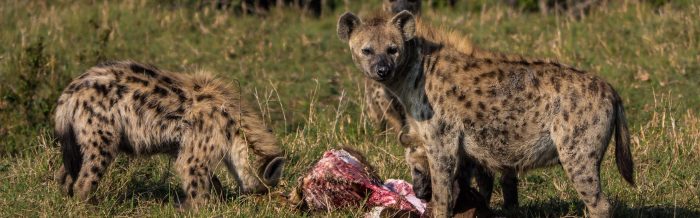
Spotted hyaenas are social and form groups called clans, composed of 3-80 members, and larger clans claim prime territory with large prey concentrations.

The spotted hyaena is well known for its variety of vocal communication and is known as the "laughing hyaena" because its trademark giggling call associated with fear or excitement.

Spotted hyaenas are threatened by a decline in their prey densities due to habitat loss caused by increased human settlement, overgrazing by livestock, and game-meat hunting by humans.
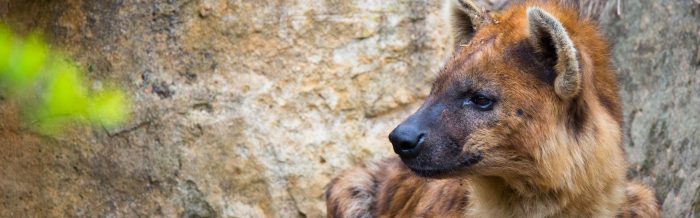
Spotted hyaenas have a reputation for being mostly scavengers, but are, in fact, effective and flexible hunters and hunt for 70% of their food.
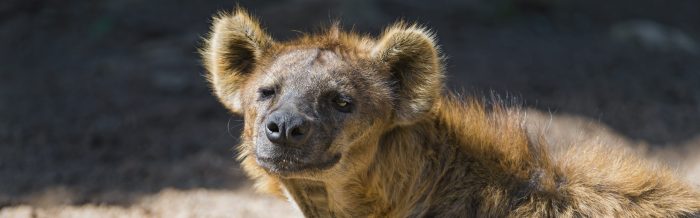
The spotted hyaena is strongly built with a massive neck and large head and, unlike other hyaenas, has rounded ears.
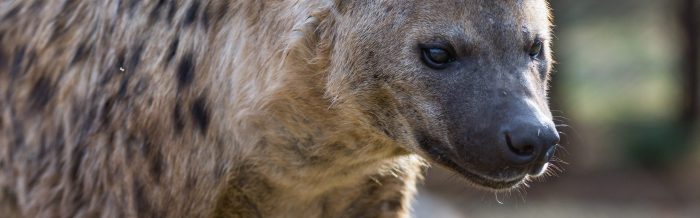
Spotted hyaenas are named for the dark spots that cover their coarse and wooly sandy-gray coats that are darkest in young animals and almost absent in old individuals.

The spotted hyaena is listed as "Least Concern" on the IUCN Red List as the species remains widespread and the total world population well exceeds 10,000 mature individuals.

The lion is the spotted hyaena's greatest natural enemy as they compete directly for food, scavenge each other's kills, and have antagonistic encounters that may result in death.

Spotted hyaenas were once a common species in most of sub-Saharan Africa, but now have a patchy distribution south of the Sahara.

The average lifespan of the butterfly viper in captivity is 8.3 years.

Butterfly vipers are sometimes found in shallow pools and have been described as powerful swimmers.

Butterfly vipers display sexual dimorphism as females are larger and males have more subcaudal scales.

After the butterfly viper sheds its skin, the bright colors fade quickly as silt from their moist habitat accumulates on the scales.

Because of the butterfly viper's restricted geographic range, few bites have been reported and no statistics are available, but at least one death has occurred.

The butterfly viper is a slow-moving snake that uses its scales for movement, stretching its skin across its ribs and releasing the tension to slither, like other snakes.

Butterfly vipers are bred domestically and sold online in the exotic pet trade.
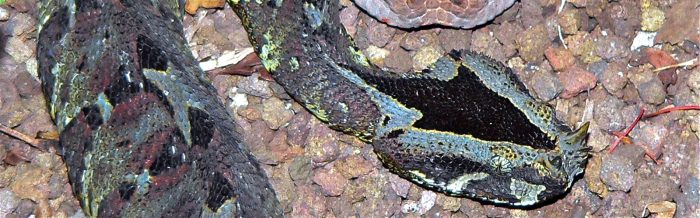
The butterfly viper's closest relative is the rhinoceros viper (Bitis rhinoceros), which has a duller color pattern, wider head, and lacks the distinct, black arrow mark on the head.

The butterfly viper is known as the "River Jack" because of its moist habitat preference and often lives near water or in a swampy environment.