Hawksbill turtles can be distinguished from other sea turtles by their extra prefrontal scales, extra forelimb claws, overlapping scutes, and elongated, sharp beaks.

Join a creative community focusing on a unique animal each month.
The hawksbill turtle is a sea turtle that can be found in shallow, warm waters off the coast of nearly every continent, aside from Antarctica. Named for the sharp, pointed beak that resembles the beak of a bird of prey, this turtle can be easily identified from others, such as the green turtle. A migratory, species, the hawksbill travels miles within the seas, but always returns to its place of birth to breed and lay its own eggs. Unfortunately, the trip from the beach to the ocean is a dangerous adventure for newborn hawksbill turtles.
Hawksbill turtles can be distinguished from other sea turtles by their extra prefrontal scales, extra forelimb claws, overlapping scutes, and elongated, sharp beaks.
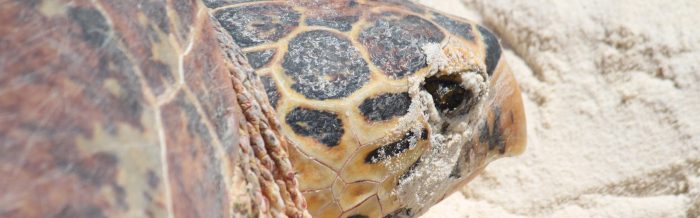
Hawksbill turtles are long-lived and mature slowly, taking 20-40 years to fully develop and averaging a 20-50 year lifespan.

In general, hawksbill turtles are found in water no deeper than 18.3 m., or 60 ft., but larger turtles may inhabit deeper sites.

Hawksbill turtles are omnivorous and feed primarily on sponges, preferring certain species of sponges found in shallow shoals abundant with brown algae.
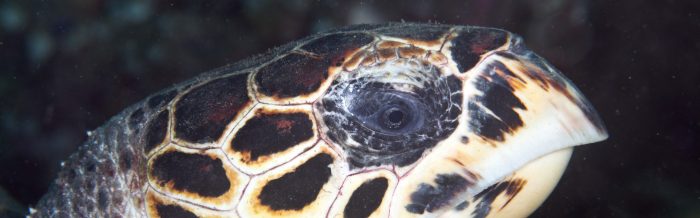
The hawksbill turtle gets its name from the elongated, tapered, sharp point at the end of its beak that gives the appearance of a bird's beak.

Hawksbill turtles are relatively small sea turtles averaging 65-89 cm. long and 40-75 kg., however nesting females tend to be larger and heavier.