Tiger sharks live longer in the wild than in captivity, averaging 27 years and a maximum age estimated at 37 years.

Join a creative community focusing on a unique animal each month.
Tiger sharks live longer in the wild than in captivity, averaging 27 years and a maximum age estimated at 37 years.

Tiger sharks have no parental investment, so pups are born fully developed and independent with traits that help them survive without parents such as camouflage patterning, teeth, and speed.

Tiger sharks share a commensal relationship with remoras, small suckerfish that attach to the sharks for transportation and protection while feeding on materials dropped by the predators.
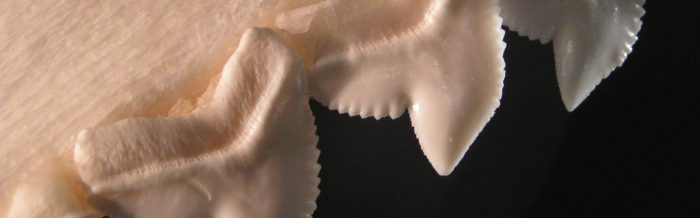
Tiger sharks have serrated teeth, making it easy to tear flesh and crack the bones and shells of their prey.

The tiger shark is the only species of the Carcharhinidae family that is lecithotrophic viviparous, giving birth to 26-33 live young in a protective nursery after a gestation of 13-16 months.

The tiger shark uses its heterocercal tail as its primary source of propulsion, moving in an S-shaped fashion.

There is regional variability in the size and age that tiger sharks sexually mature and males mature earlier than females, at 25-30.5 m. compared to females at 27.4-34.5. in length.

The tiger shark is found in the epipelagic zone of 0-200 meters and occasionally makes longer-distance excursions into the mesopelagic zone of 200-1,000 meters.

Tiger sharks display sexual dimorphism in body size as females are smaller than males.

Tiger sharks are a popular gamefish typically captured and released for sport, but can be tiring to fish as they're fast, strong, and not quickly or easily exhausted.

Do you think you know the tiger shark? Test your knowledge of tiger shark FaunaFacts with this trivia quiz!

Tiger sharks are solitary except during the mating seasons or while communally feeding when a loose social hierarchy is followed, allowing larger, more dominant sharks to feed before smaller ones.

Due to exploitation from commercial, recreational, and unregulated fisheries, the tiger shark has a "Near Threatened" evaluation on the IUCN Red List of Threatened Species and is close to meeting "Vulnerable".

Tiger sharks spend 36% of their time in shallow coastline habitats up to 145 m., and females are observed in shallow areas more often than males.

The tiger shark is nomadic and highly mobile and has been documented traveling up to 16 km. in a single day.

Tiger sharks are polygynandrous, mating once every three years and breeding earlier in the northern hemisphere, from March-June than in the southern hemisphere, from November-March.

Tiger sharks live shorter lifespans in captivity, averaging 17-20 years, often dying of starvation due to the lacking appeal of dead food.

The tiger shark is caught by commercial, recreational, small-scale, and artisanal fisheries as a target species or incidental bycatch for its high quality fins, skin, liver oil, meat, and cartilage.

Large tiger sharks can survive several weeks without feeding.

The tiger shark has a circumglobal range in subtropical and tropical, warm, temperate oceans, ranging between latitudes of approximately 40°N to 36°S.

The tiger shark's common name originates from the tiger-like stripes on the backs of juveniles that allow them to blend in with their environment.

Tiger sharks are nocturnal predators that rely on stealth and camouflage rather than strength and speed to catch prey.

The tiger shark is a saltwater species and inhabits marine neritic and oceanic habitats near shelves, seagrass, and coral reefs.

Tiger sharks are carnivorous and eat mollusks, birds, snakes, crustaceans, sea turtles, dugongs, and even dead or injured whales.

Tiger sharks are one of the largest ocean predators and the largest member of the Carcharhinidae family with a sizeable blunt nose on the end of a wedge-shaped head.

Vetrina Nicole Art portrayed an ominous silver fox reaper character engrossed in eerie red lighting. With a minimalistic, stark background contrasting with the highly detailed and rendered fur, this piece gives the viewer chills and brings about a sense of wonderous curiosity.

The red fox's manus has five claws and the pes four claws with the first digit, the dew claw, not making contact with the ground.

Because red foxes have caused considerable damage on fauna where they've been introduced, such as in Australia, they are being controlled with sodium fluoroacetate baits.

The red fox's tooth row is more than half the length of the skull and the molar structure emphasizes crushing.

The red fox is not listed in CITES at species level, but the subspecies griffithi, montana, and pusilla are listed on CITES Appendix III.

Red foxes help control prey populations and disperse seeds, but are widely regarded as a pest, threatening poultry and transmitting rabies.

Red fox pups are born blind and are cooperatively cared for and provided with solid food by the mother, father, and sometimes unmated helpers and older offspring until the pups leave in the autumn following their birth.