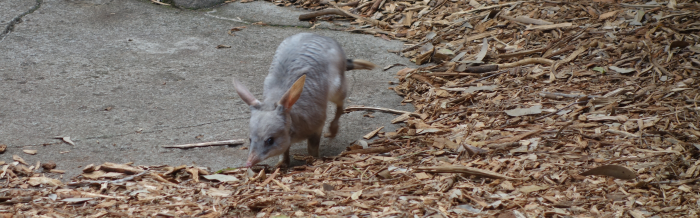
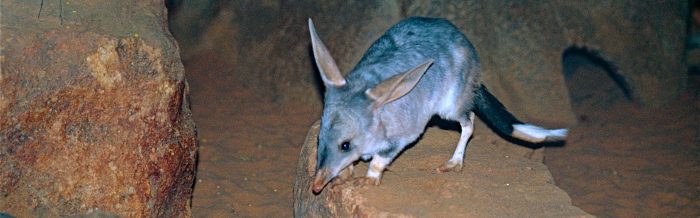
The bilby is evaluated as "Vulnerable" on the IUCN Red List because it is patchily distributed with a small area of occupancy, has a population size less than 10,000, and is suffering ongoing declining population trends.
Join a creative community focusing on a unique animal each month.
The bilby is evaluated as "Vulnerable" on the IUCN Red List because it is patchily distributed with a small area of occupancy, has a population size less than 10,000, and is suffering ongoing declining population trends.
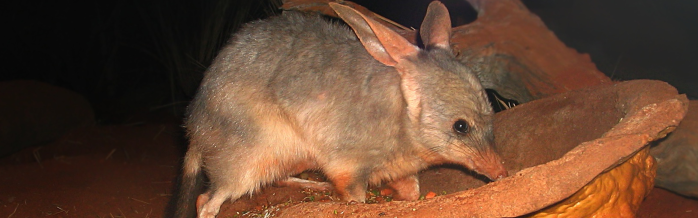
Do you think you know the bilby? Test your knowledge of bilby FaunaFacts with this trivia quiz!
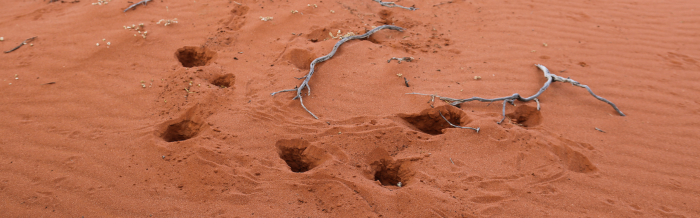
Bilbies are terrestrial and semi-fossorial and dig slightly spiraling burrows with multiple exits that serve as protection from predators, sun, and other environmental conditions.
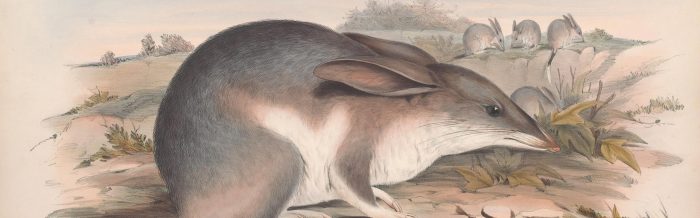
The bilby was once known as the "greater bilby", but is often referred to simply as the "bilby" since its closest relative, the yallara, or lesser bilby became extinct in the 1930's and 1960's.

Yodeldog used a digital medium to portray both the cuteness of the European mink and the ferocity of its aquatic hunting within a storybook-like illustration. With a cohesive color palette and dynamic composition, this piece truly embodied many facets of this aquatic mustelid's life.

An attempt to introduce the European mink to the southern Kurile Islands failed to establish a population, but a small breeding population of 100 was established on an island in Estonia.

Predators of the European mink include the western polecat, American mink, golden eagle, red fox, and large owls.

During the mating season, the sexual organs of female European mink enlarge greatly and become pinkish-lilac, as opposed to the American Mink, whose organs don't change.

Due to the higher quality of farmed American mink, European mink are not trapped for commercial purposes as much as they once were.

Young European mink open their eyes after 1 month and begin tracking and capturing prey at 2 months before dispersing at 2.5-4 months.

The decline of noble crayfish may be a factor in declining European mink numbers, as minks are notably absent in the eastern side of the Urals, where crayfish are also absent.

The European mink hybridizes with western polecat at low levels as only pure polecat males can mate with pure European mink females.

There is sexual dimorphism in the European mink as males are longer than females and have longer tails.

The European mink paddles with its short, membraned front and back limbs simultaneously and can stay underwater for 1-2 minutes, but is not as efficient underwater as the American mink.

Currently, seven subspecies of European mink are recognized.
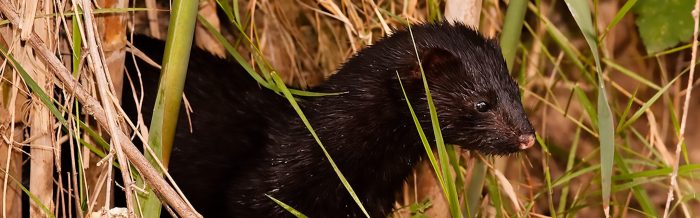
The European mink does not form large territories, possibly due to the abundance of food on the banks of small water bodies.

The European mink primarily hunts for aquatic prey in riparian zones and in the water, and voles are its most important food source.

In the early 20th century, 40,000-60,000 European mink were caught annually in the Soviet Union for the fur trade, an estimate which exceeds the modern global population.
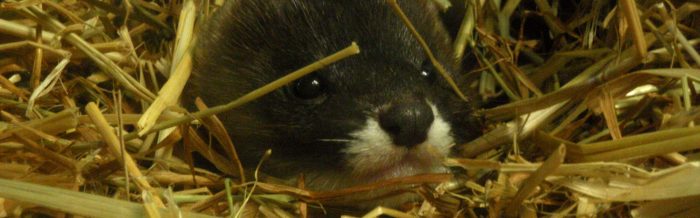
The European mink is more sedentary than the American mink and confines itself for long periods in permanent burrows and temporary shelters near the water's edge lined with straw, moss, mouse wool, and bird feathers.
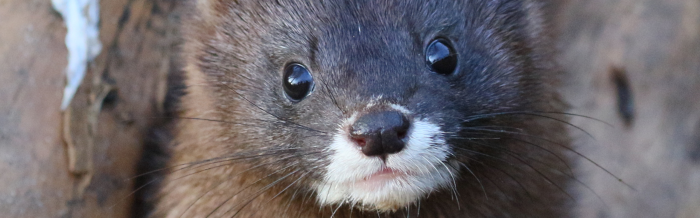
The European mink has an evenly distributed brown or black coat color that is lighter in the summer and, unlike the American mink, its chin and lips are pure white.

European mink show the curious phenomenon of delayed implantation, and after a gestation of 35-72 days, give birth to 2-7 young in April and May.
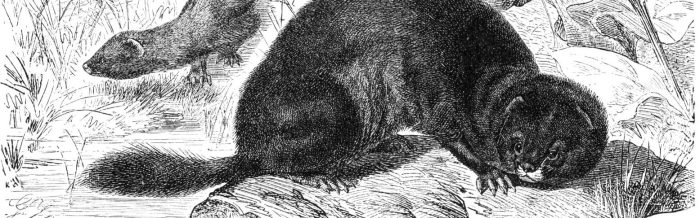
The European mink is a medium-sized, elongated, semiaquatic species of mustelid more closely related to the western polecat and Siberian weasel than to the American mink.
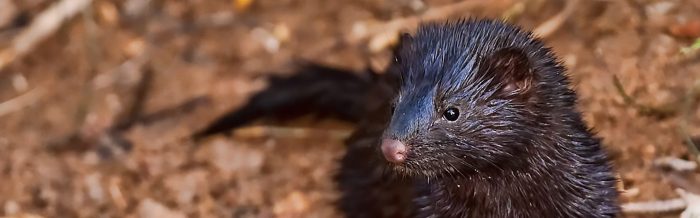
Populations of European mink have decreased more than 50% over the last 10 years for ecological and commercial reasons and are predicted to decline more than 80% over the next 10 years.

The European mink has a large, broad head with short ears that are less specialized for carnivory than that of polecats and the American mink, bearing more infantile features, weaker dentition, and less strongly developed projections.
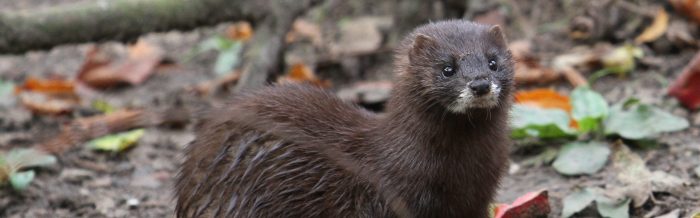
Although the current global population of European mink is unknown, numbers were estimated at 30,000 in 2001.

The European mink has a short tail that makes up about 40% of its total body length.

The European mink is "Critically Endangered" because of a loss of over half the population due to habitat loss, water pollution, hydroelectric constructions, and invasive species, notably American mink.

European mink are crepuscular and are most active around dusk and before day break.

The European mink is carnivorous and has a diverse diet consisting largely of aquatic and riparian fauna, such as mammals, birds, frogs, fish, insects, and crustaceans.
Do you think you know the European mink? Test your knowledge of European mink FaunaFacts with this trivia quiz!

The European mink has a very thick and dense, water-repellent coat that is shorter, less dense, and more loosely fitting than that of the American mink.

The European mink's daily food requirement is 140-180 g. (4.9-6.3 oz.) and it will cache its food in times of abundance.