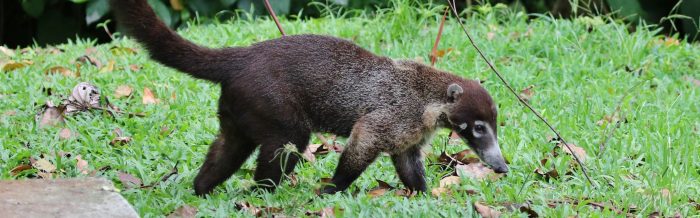
Although the white-nosed coati searches for food both on the ground and in the forest canopy, frequently climbing to obtain fruits, it is more typically seen on the ground and is considered terrestrial.
Join a creative community focusing on a unique animal each month.
Although the white-nosed coati searches for food both on the ground and in the forest canopy, frequently climbing to obtain fruits, it is more typically seen on the ground and is considered terrestrial.

Adult male white-nosed coatis are sometimes active at night, but coatis are primarily diurnal and spend the day foraging on the ground before sheltering in the treetops at night.

White-nosed coatis will travel up to 2,000 meters in a single day in a quest for food, foraging with their muzzle close to the forest floor to sniff.

In February or March, the most dominant male white-nosed coati will breed with each member of the band in a tree and is driven away afterward due to his juvenile-killing behavior.

White-nosed coatis are omnivores that primarily eat insects, but will feast on beetles, spiders, scorpions, ants, termites, grubs, centipedes, crabs, fruit, mice, lizards, and frogs.
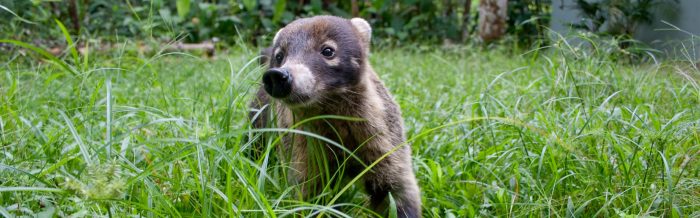
Adult male white-nosed coatis live territorial, solitary lives and establish non-overlapping ranges that they mark by spraying urine or dragging their abdomens on a surface and spreading anal secretions.

The white-nosed coati's black ring-covered tail makes up over half its body length and is held erect while walking.
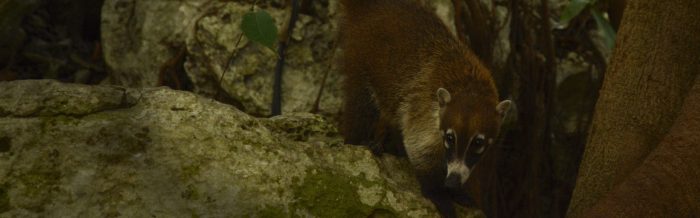
The white-nosed coati's population details are unknown, but estimates range from rare in the United States to common in Costa Rica.
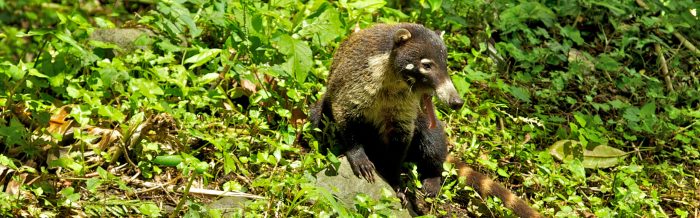
White-nosed coatis are highly adaptable, but basically inhabit subtropical/tropical dry high-altitude forests and grasslands, as well as moist lowland forests.

White-nosed coatis live in protective bands of 4-30 individuals including males up to two years of age and females who are not necessarily related.

The white-nosed coati is native to North and South America and ranges from southeastern Arizona through Mexico and Central America and into western Colombia and Ecuador.
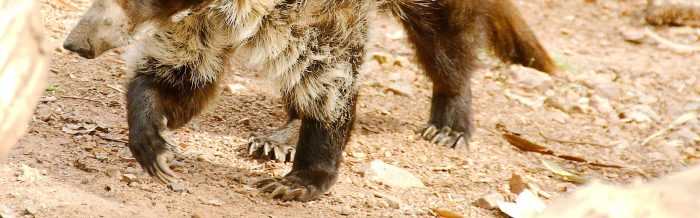
The white-nosed coati is plantigrade with shorter forelegs than hindlegs and black, clawed feet with naked soles.

Do you think you know the white-nosed coati? Test your knowledge of white-nosed coati FaunaFacts with this trivia quiz!
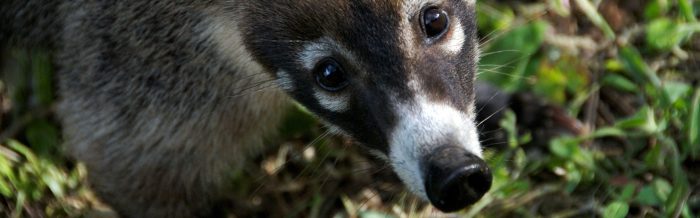
The white-nosed coati is also known as the "coatimundi", originating from Tupian Indian and translating to "belt nose", referring to the way it tucks its nose under its belly as it sleeps.

Mitochondrial analysis revealed the Gulbaru leaf-tailed gecko to be a deeply divergent lineage with closer affinities to mid-east Queensland congeners than geographically neighboring geckos.
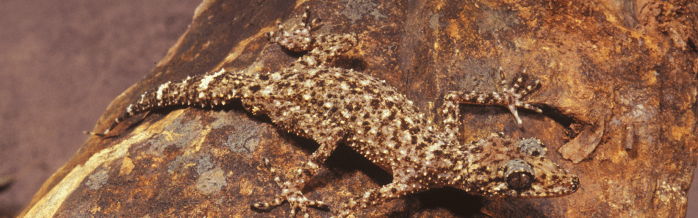
The establishment of protected areas, effective fire management, and keeping the identity of localities secret is recommended to reduce the rate of habitat loss occurring within the Gulbaru leaf-tailed gecko's range.
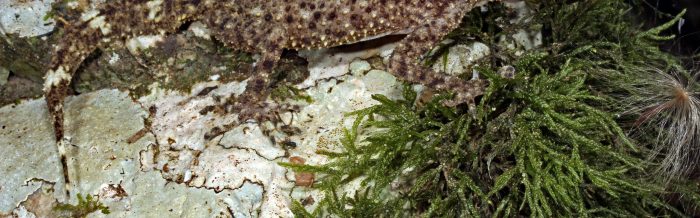
Although the Gulbaru leaf-tailed gecko's population trend is unknown, the extent and quality of habitat has declined at least at two localities.

Nenelink painted an 8″x10″ monochromatic acrylic painting of the small Gulbaru leaf-tailed gecko in shades of blue and violet. Emphasizing the blotchy, patterned visual texture of the reptile against a busy, impressionistic background, Nene utilized the gecko’s strengths to create a beautiful piece of work.
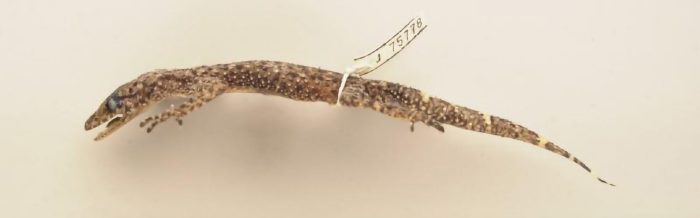
Collection for the pet trade represents the only major threat to the remaining Gulbaru leaf-tailed gecko localities.
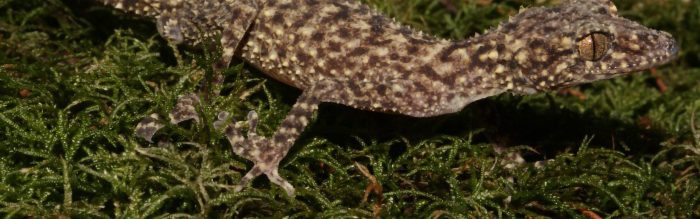
The Gulbaru leaf-tailed gecko's ear opening is elliptical and vertical with raised projection overhangs on the upper margin.

There is no population information available for the Gulbaru leaf-tailed gecko.
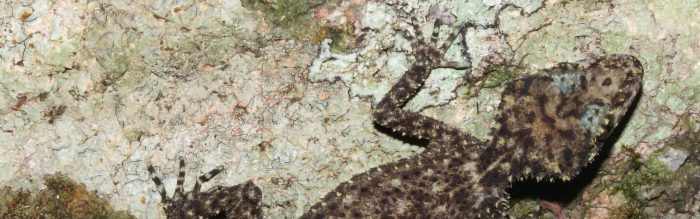
The Gulbaru leaf-tailed gecko's population is considered severely fragmented and densities vary between sites.
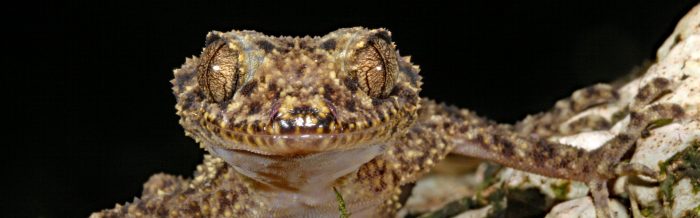
The Gulbaru leaf-tailed gecko has a large, depressed, triangular head that is distinct from the neck and covered in small granules.
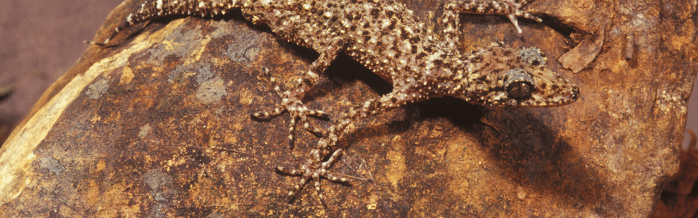
Only a small fraction of the Gulbaru leaf-tailed gecko's suitable habitat is protected.
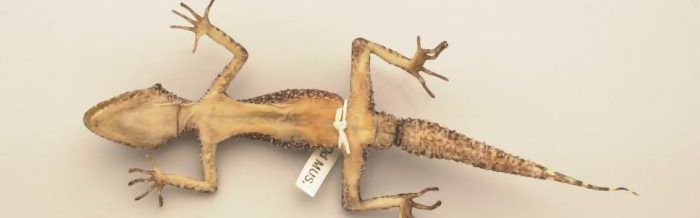
The Gulbaru leaf-tailed gecko is not currently found in trade but is desirable and might well be targeted by collectors.
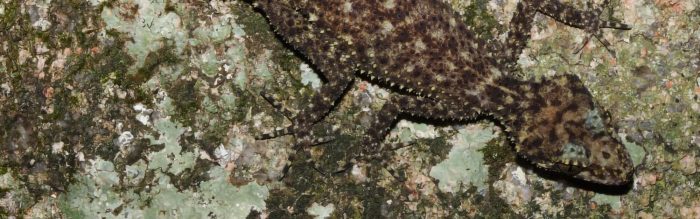
The rainforest-dependent Gulbaru leaf-tailed gecko is threatened by unmanaged burning and grazing that is severely fragmenting and destroying the remaining forest.

The Gulbaru leaf-tailed gecko is thought to have similar reproduction as the broad-tailed gecko, mating until autumn and females storing sperm through winter.
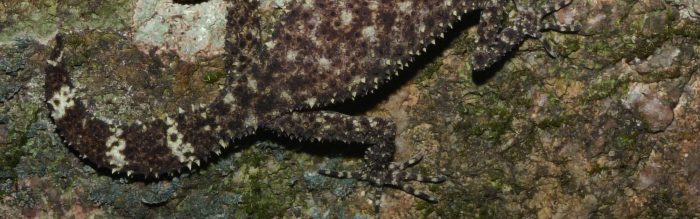
The Gulbaru leaf-tailed gecko has the ability to regenerate its tail.
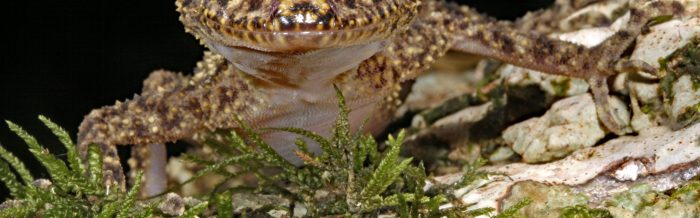
The Gulbaru leaf-tailed gecko is endangered due to a low extent of occurrence, a severely fragmented distribution, and a continuing decline in the extent and quality of its habitat as a result of burning and grazing.
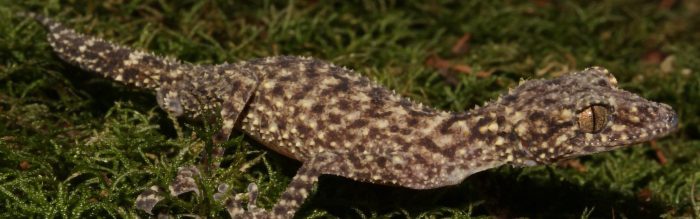
The Gulbaru leaf-tailed gecko appears to be completely forest dependent.
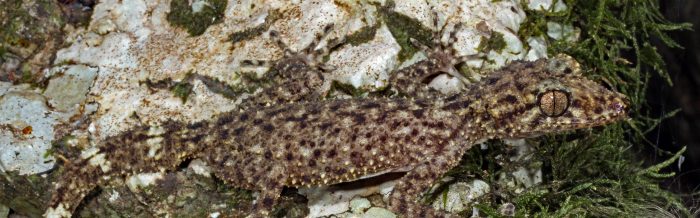
Do you think you know the Gulbaru leaf-tailed gecko? Test your knowledge of Gulbaru leaf-tailed gecko FaunaFacts with this trivia quiz!
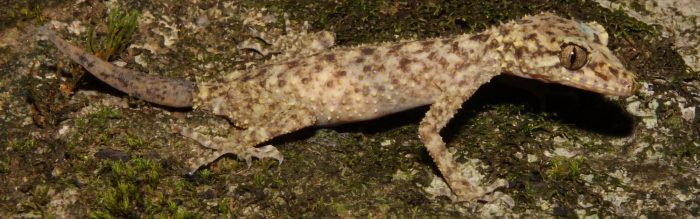
Gulbaru leaf-tailed geckos are small at 89 millimeters long.