Ring-tailed lemurs possess the most complex scent marking behavior of primates and use scent for territorial defense, mate evaluation, and intrasexual competition.
Join a creative community focusing on a unique animal each month.
Ring-tailed lemurs possess the most complex scent marking behavior of primates and use scent for territorial defense, mate evaluation, and intrasexual competition.

Along with other species of lemurs, ring-tailed lemurs are responsible for several wildlife reserves being put into place and protecting all other plant and animal species in the area.

Female ring-tailed lemurs typically mate with multiple males during estrous, so males will compete amongst themselves for the right to mate.

Ring-tailed lemurs have improved the economy of Madagascar as they are a common draw for ecotourism.

Ring-tailed lemurs begin mating in April and give birth to 1-2 offspring between August and September after a gestation of 130-144 days.

Because the ring-tailed lemur's habitat has been altered by humans, their range is large, but their distribution is patchy and dependent on forest cover.

Ring-tailed lemurs are diurnal and search for food from dawn until dusk before huddling together at night to sleep.

Ring-tailed lemurs have four thin fingers and a thumb, with an opposable first toe on the lower appendage to help with climbing trees.

Ring-tailed lemurs have a complex social hierarchy in which females are dominant over males and stay within their native troop.

Ring-tailed lemurs are well-known for their thermoregulatory "sunning" postures, in which they sit upright with their forearms on their knees.

Because of their highly seasonal environment, ring-tailed lemurs are opportunistic omnivores and must exploit a wide variety of food sources throughout the year.

There is no physical sexual dimorphism in the ring-tailed lemur as male and females average the same size of 42.5cm and 2.2kg.

The fur of a ring-tailed lemur is thick and dense and is a solid color ranging from gray to brown being lighter around the face and underbelly.

Ring-tailed lemurs have overlapping home ranges, averaging 1,000m, that are seasonally expanded depending on habitat and habitat quality.

Madagascar's lemurs, including the ring-tailed lemur, are the most endangered group of mammals and represent the highest primate conservation priority in the world.

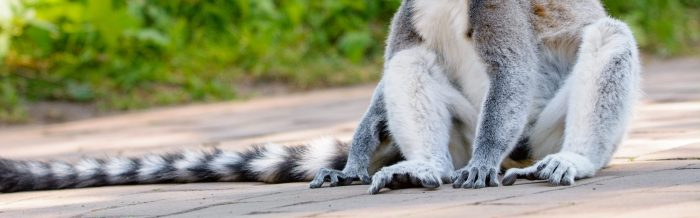
The ring-tailed lemur is named for its long, thick, black-and-white-ringed tail and is the only lemur species to possess a striped tail.

Ring-tailed lemurs are found in rainforests, continuous canopy, humid montane, subalpine, dry deciduous, gallery, mixed, dry brush, and spiny thorn, scrub bush forests.

Ring-tailed lemurs are endemic to 9 forests in southern and southwestern Madagascar on the continent of Africa.

Ring-tailed lemurs are highly social and live in groups of 15 to 30 called troops, the largest of any lemur species.

Zoe created a mostly achromatic, stylized illustration that beautifully honored the complicated textures and patterns of the hawksbill turtle. Intricate linework and attention to detail created with paint pen and gold acrylic paint on paper delivers a calming, rhythmic sense.

The holiday season is approaching and FaunaFocus wants to spread the cheer! Throughout the months of November and December, FaunaFocus will be hosting a Holiday Art Trade and all are welcome to join! Surprise someone with an animal-themed artwork of their choice and receive an artwork yourself, "Secret Santa" style! GET INVOLVED Sign Up: … Continue reading Holiday Art Trade 2018: Sign-Up

The hawksbill turtle communicates by the use of ritual mating behaviors and breeds in shallow waters near the shore.

Male hawksbill turtles are distinguished from females by a brighter pigmentation, a concave plastron, long claws, and a thicker tail.

Hawksbill turtles are found in shoals, sea grass, algal beds, mangrove bays, lagoons, islands, creeks, mud flats, continental shelves, and hard-bottomed and reef habitats containing sponges.
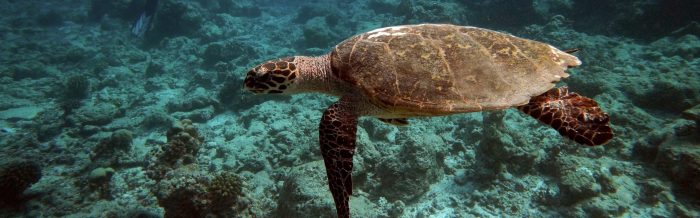
Once sexually mature, most hawksbill turtles undertake complex movements and become highly migratory, but some may settle near their natal beaches.

The hawksbill turtle inhabits the tropical and subtropical waters of the Atlantic Ocean, Indian Ocean, and Pacific Ocean and reside on the coasts of more than 108 countries.

Hawksbill turtle mating occurs in shallow waters every 2-3 years, but it's unknown whether the turtles are promiscuous or monogamous.
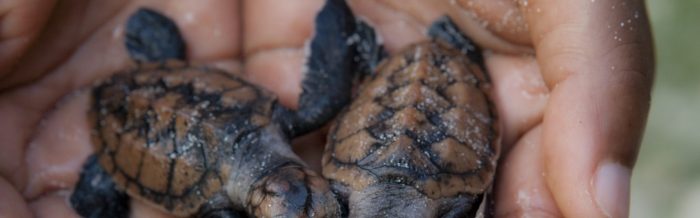
Young hawksbill turtles are unable to dive into deep water and gather in masses of floating sea plants until they're older.
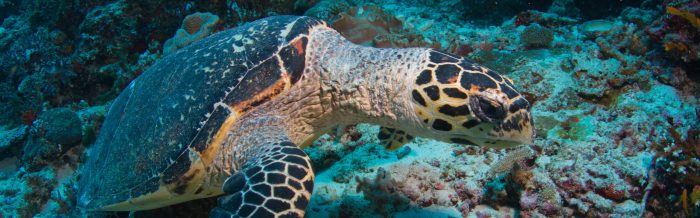
Hawksbill turtles play a positive role in the ecosystem by contributing to marine and coastal food webs and transporting nutrients within the oceans.
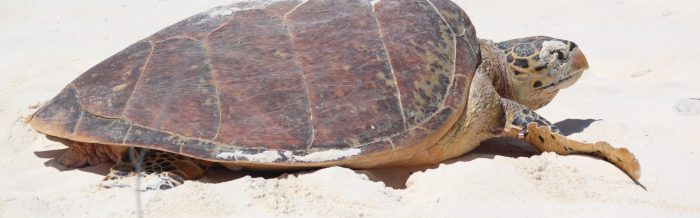
The entire hawksbill turtle nesting process takes roughly 1-3 hours in which the turtles dig pits, lay their eggs, then cover the nests and return to the sea.

Only about 1 in 1,000 hawksbill turtles will survive to adulthood because they must scramble to the ocean, directly after hatching, while avoiding predators.
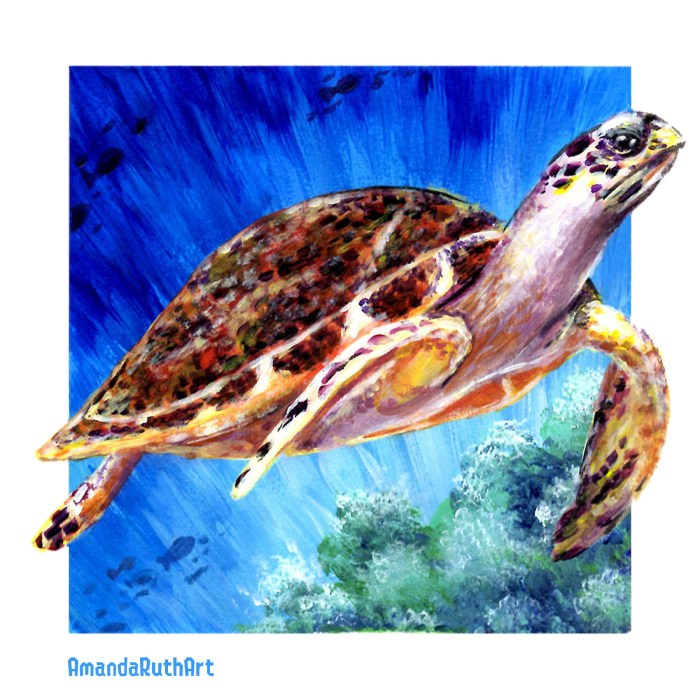
FaunaFocus raised $836 for World Wildlife Fund-Australia (WWF's Wild-Livestream event benefitting sea turtles, such as the endangered green turtle and the critically endangered hawksbill turtle.