Common palm civets are kept in captivity in Java and the Philippines as pets, coffee producers, and rodent catchers.

Join a creative community focusing on a unique animal each month.
Common palm civets are kept in captivity in Java and the Philippines as pets, coffee producers, and rodent catchers.
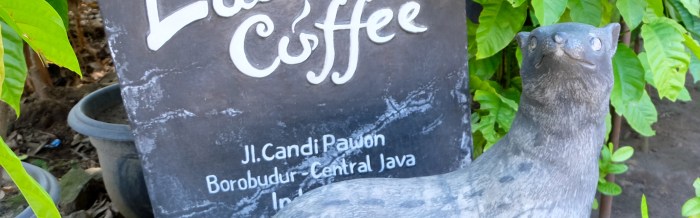
Common palm civets digest coffee cherries that are then used to produce the world's most expensive coffee, Kopi Luwak, selling for over $100 a pound.
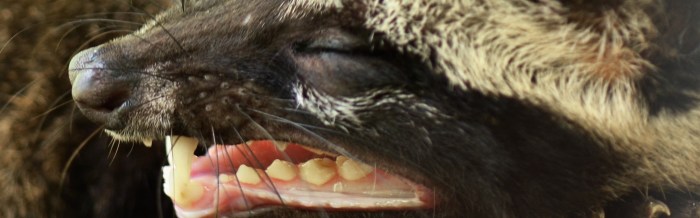
Common palm civets can be distinguished from other civets from a lack of black rings on the tail, backwards growing hair on the neck, and weaker teeth.

Common palm civets rarely communicate vocally, but can meow, snarl, hiss, moan, whine, cough, call, and spit when agitated.

Common palm civets have weaker, less developed teeth for an omnivorous diet than other civets that mostly eat meat.

The common palm civet's favorite trees to feed from are fig trees and palm tress, hence the origin of the name "palm civet".
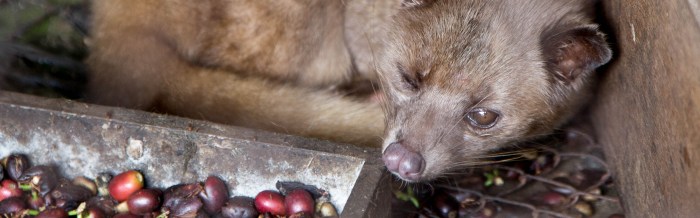
Common palm civets are omnivorous and will eat whatever is available, but are mostly frugivorous, preferring berries and pulpy fruits.

Common palm civets secrete self-identifying odors and rely on olfactory responses to communicate, instead of using vocalizations.
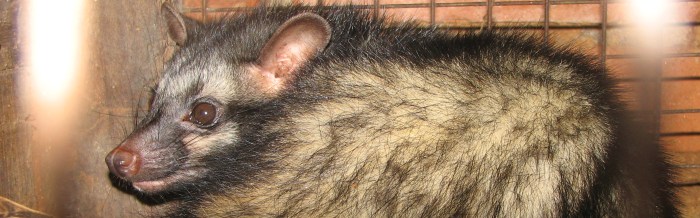
The common palm civet is Least Concern because of a wide distribution, large population, broad range, and resistances to threats.

A common palm civet can be recognized by the dark stripes on its back and the three rows of black spots freckled on each side of its body and legs.

Many subspecies of the common palm civet have been described, but there is debate over the taxonomic status of them.

Common palm civets are not considered to be in danger of extinction, but are protected under law in their native areas of Malaysia, Myanmar, India, Bangladesh, and China.

Male common palm civets are more territorial and dominant than females and mark objects more frequently.

Happy new year, everyone! The end-of-the-year holiday season has come to a close, also bringing the conclusion of the first annual FaunaFocus Holiday Art Trade! A total of 19 participants joined in spreading holiday cheer, each creating an artwork that featured an animal species requested by another participant. Throughout the months of November and December, … Continue reading Holiday Art Trade: 2017

Over-logging and clearing of land for palm oil plantations threatens the common palm civet's habitat.
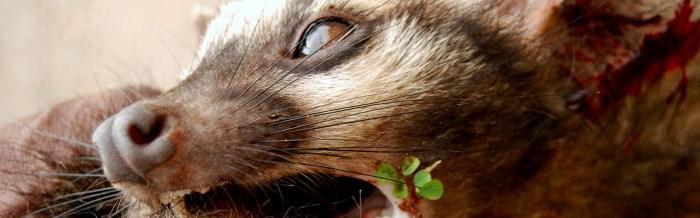
Common palm civets enjoy the sap from sugar palm trees that's used to make a sweet liquor called "toddy," hence the civet's nickname, "toddy cat".
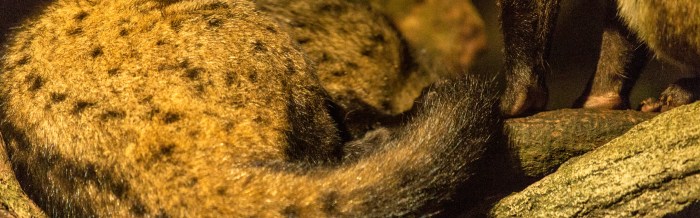
The common palm civet has a tail that is almost as long as its head and body combined.

Common palm civets have plantigrade feet, naked soles, semi-retractile claws, and partly fused toes that make them excellent climbers.
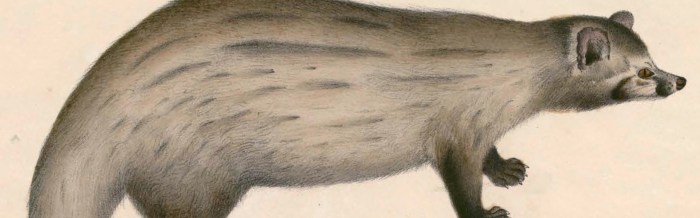
Common palm civets are known by many names based on the region in which they are found.

The arboreal and nocturnal characteristics of common palm civets developed as a mechanism to avoid predators.

Common palm civets are prime contributors to the dispersal of seeds, which helps forests regenerate.
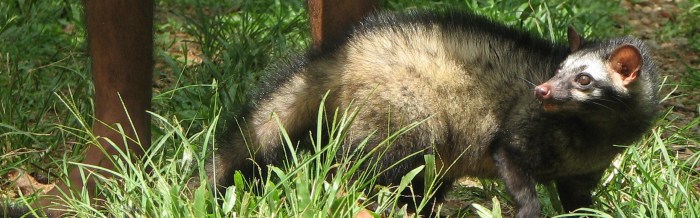
Male common palm civets have much larger ranges than females.
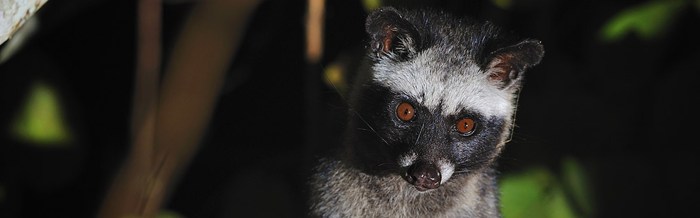
Even though common palm civets are one of the most common species of civets, little is known about their behavior.

Claire's watercolor composition displayed a complimentary purple and yellow color scheme that highlighted the plight of the white rhino. It invoked emotion within its creative and original elements.

The white rhino is far less dangerous than the black rhinoceros, but females will aggressively protect their calves.

White rhinos are larger than black rhinoceroses and have a nuchal hump, a longer head, a straighter back, and a square lip, as opposed to the hooked lip of the black rhino.

White rhinos are diurnal during the winter and crepuscular during the summer, in order to avoid the hottest parts of the day.
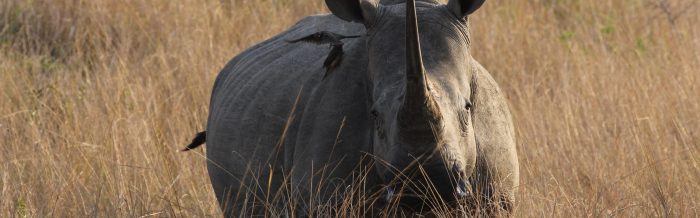
White rhinos have a mutual relationship with cattle egret and Cape sterling, as the birds remove disease-causing insects and parasites from the rhinos' hide.

White rhinos generally run at speeds of 24 km/hr, but can reach up to 40 km/hr.

The white rhino is a keystone species that helps increase the biodiversity of grasses and prevents wildfires.
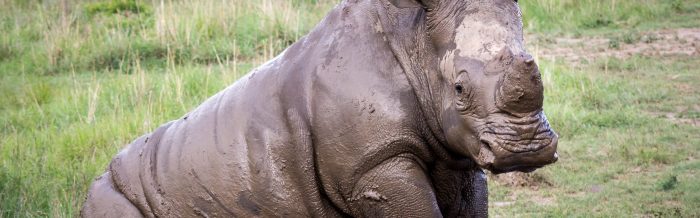
White rhinos wallow in mud baths to protect their skin and control their body temperature.

White rhinos, especially calves, are preyed on by lions and spotted hyaenas, but humans are the rhino's biggest predators.